Server Side Template Injection(SSTI)
Server Side Template Injection(SSTI)
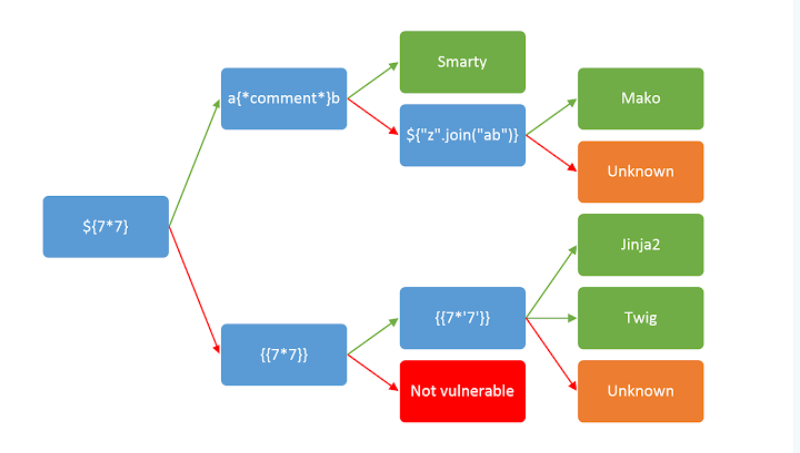
- Server-side template injection is when an attacker is able to use native template syntax to inject a malicious payload into a template, which is then executed server-side.
- In simple: SSTI occurs when user input is improperly handled in server-rendered templates, allowing attackers to execute arbitrary code on the server.
- At the severe end of the scale, an attacker can potentially achieve remote code execution, taking full control of the back-end server and using it to perform other attacks on internal infrastructure.
- Why It’s Dangerous:
- Access to files
- Execution of OS commands
- Data exfiltration
Popular Template Engines
- Jinja2 (Python/Flask): Uses `` syntax.
- Twig (PHP) Inspired by Jinja, used in Symfony and Drupal.
- Thymeleaf (Java) Used with Spring, integrates well with HTML5: uses
${ }syntax. - Handlebars (JavaScript): Focuses on logic-less templates.
- (ERB/Ruby)
<%= 7*7 %>
How SSTI Happens: The Vulnerable Code
- Developers often try to create dynamic content by directly adding user input into templates:
template = "Hello " + user_input + "!"
render_template(template)
If user_input = “”, this may get evaluated to 49 on the server.
Tool
- There is a tool that
- Tplmap is an automated cyber security tool that can perform checking and exploitation of SSTI (Server-side template injection) vulnerability.
- Tplmap tool supports lots of template engines like PHP, Ruby, Python, Jinja2, and Tornado.
- Installation & Setup:
- Step 1
git clone https://github.com/epinna/tplmap.git - Step 2
cd tplmap - Step 3
sudo pip3 install -r requirements.txt - Step 4(Exploiting the vulnerability)
python3 tplmap.py --os-shell -u 'http://www.target.com/page.php?id=1*'
- Step 1
A quick approach