Challenge Overview:
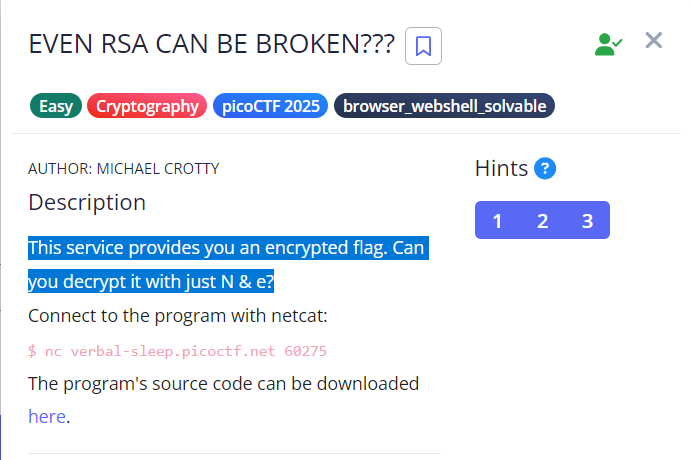
- The following was the description for the challenge:
Intro
- RSA, which is a public-key cryptography, is an asymmetric encryption that relies on the difficulty of factorizing the modulus N.
- Modulus N is the product of two large prime numbers, p and q.
- so because of limited computing power in the old days, computers were slow, making factoring large numbers (n = p * q) computationally infeasible.
- Hence, it made sense for it be regarded as a strong encryption.
- But, the modern technology and considering “quantum computing” in the future makes these encryption methods easy to break.
Approach
- First We Have To Understand How RSA works:
- The plaintext(m) is converted into an integer
- Encryption is performed using the public exponent(e)-regarded as public key, and Modulus N: Ciphertext(C) = m^e * mod N)
- The ciphertext C that is generated is sent to the receiver.
- Decryption uses a private key (d) and Modulus(N): Plaintext = C^d * mod N